TL;DR
- Who Must Pay: Self-employed individuals, independent contractors, and small business owners in NWA must pay Quarterly Estimated Taxes (QETs) if they expect to owe $1,000 or more annually. These payments cover Federal Income Tax and the 15.3% Self-Employment Tax.
- When to Pay: QETs are due on a specific schedule (Apr 15, Jun 15, Sep 15, and Jan 15 of the following year). NWA businesses must also meet separate State Estimated Tax Requirements for Arkansas and/or Missouri.
- Avoiding Penalties: To avoid costly Underpayment Penalties, taxpayers must meet the Safe Harbor Rule by paying at least 90% of the current year’s liability or 100% (or 110% for high earners) of the previous year’s liability.
- Crucial Distinction: Filing a tax extension (using Form 4868 or 7004) only grants extra time to file the paperwork, not extra time to pay the tax owed. Payment is still due by the original April deadline.
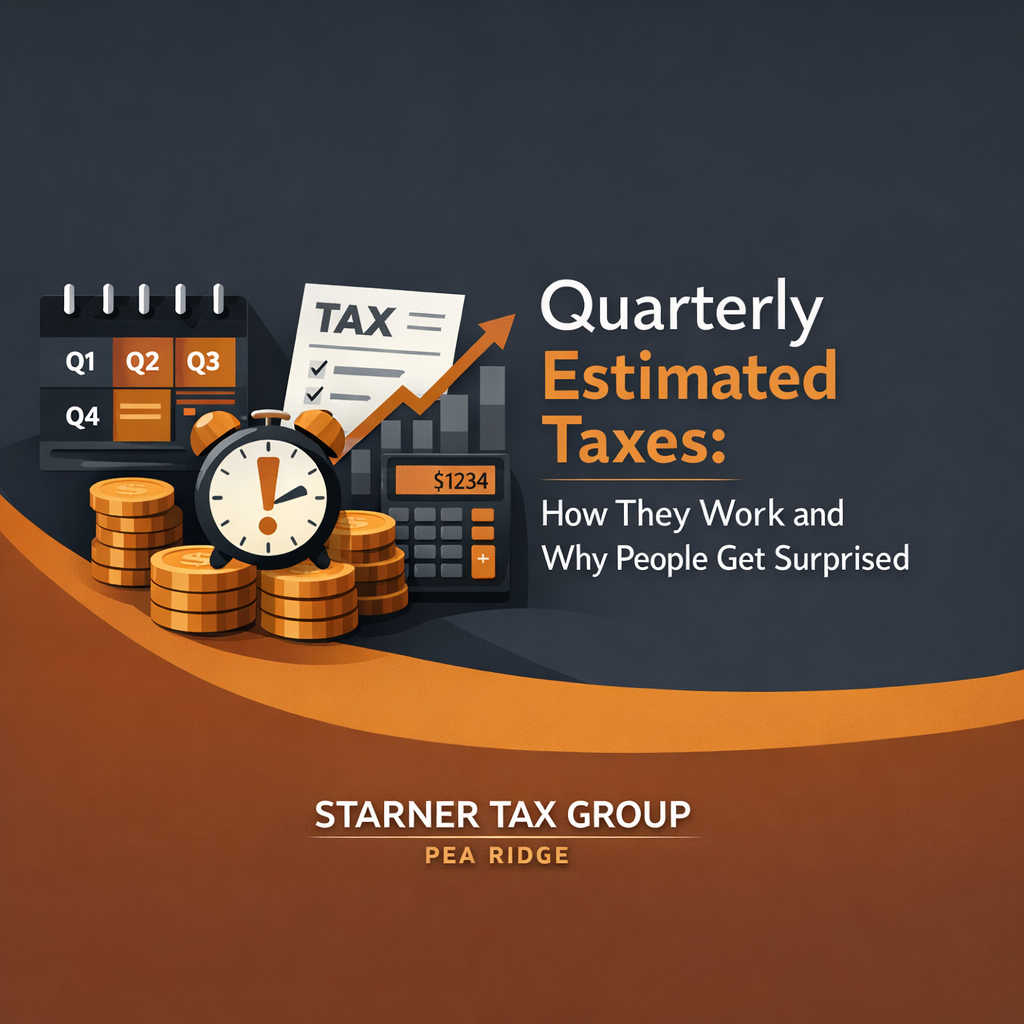
Estimated Quarterly Taxes: Why NWA Small Business Owners Get Surprised
If you are a self-employed individual, an independent contractor, or one of the many growing small business owners in Northwest Arkansas (NWA), your income is rarely steady.
One busy season serving clients in Bentonville or a successful project in Rogers can significantly shift your entire financial picture.
Unlike traditional W-2 jobs where taxes are automatically withheld, the responsibility for paying your Federal income tax and Self-employment tax falls entirely on you.
The IRS requirements state that taxes must be paid throughout the year, not just in one large payment when you file your annual tax return.
This is the fundamental reason why Quarterly Estimated Tax Payments exist.
These estimated taxes cover both your typical income tax liability and the Self-employment tax, which includes your Social Security tax and Medicare tax contributions.
If you ignore these payments, you risk an unwelcome surprise: a huge tax bill and potentially costly underpayment penalties when you file.
Starner Tax Group Pea Ridge specializes in helping busy owners like you stay compliant, reduce stress, and avoid those unexpected financial hits.
We provide the personalized guidance needed to accurately calculate estimated tax, whether you are a sole proprietor, an LLC member, or an S Corporation owner.
Understanding Quarterly Estimated Tax Payments
What exactly are quarterly estimated tax payments? Simply put, they are advance deposits you make toward your expected annual tax bill.
The IRS requirements mandate this system to ensure that taxpayers pay income taxes as they earn money. This is often called the “pay-as-you-go” system.
If you work a typical W-2 job, your employer handles tax withholding, meaning your taxes are automatically withheld from every paycheck. But if you are self-employed, you must pay your own taxes four times per year.
What Your Estimated Taxes Cover
For self-employed individuals, independent contractors, and small business owners in Northwest Arkansas, these quarterly payments cover more than just standard income tax.
Your estimated tax payments must cover several different types of taxes:
- Federal Income Tax: This is the standard tax applied to your yearly earnings.
- Self-employment tax: This is a crucial component that covers your required contributions toward the federal Social Security tax and Medicare tax.
When you are an independent contractor or sole proprietor, you are responsible for both the employee and employer portions of these payroll taxes, which is why the Self-employment tax rate is 15.3% on most of your net earnings.
Who Must Pay Quarterly Taxes?
The primary rule set by the IRS is straightforward: if you expect to owe $1,000 or more in estimated federal income taxes for the year, you generally need to make quarterly tax payments.
This includes most Small Business Owners, Sole Proprietors, LLC Members, and freelancers who are generating revenue in communities like Bentonville and Rogers.
A second, related rule applies specifically to the Self-employment tax: if you are a self-employed individual with net earnings of $400 or more, you must pay the Self-employment tax on those earnings, which is included in your overall quarterly taxes calculation.
Failing to make these payments throughout the year can lead to an unexpected surprise when you file your annual tax return, and potentially trigger underpayment penalties from the IRS.
To calculate estimated tax, the IRS Form 1040-ES provides worksheets designed to help you determine your proper tax payment liability based on your projected income and deductions.
Understanding the Quarterly Tax Deadlines for 2026
One of the biggest pain points for small business owners is remembering the quarterly tax due dates. Unlike the annual April 15 deadline, these payments are spread throughout the year.
While the exact dates may shift slightly if they fall on a weekend or holiday, the standard 2026 payment deadlines for quarterly taxes are:
- Period 1 (Jan 1 , Mar 31): Due April 15
- Period 2 (Apr 1 , May 31): Due June 15
- Period 3 (Jun 1 , Aug 31): Due September 15
- Period 4 (Sep 1 , Dec 31): Due January 15 of the following year
Note that the payment for the final quarter is due in January, even though your final return is not due until April 15. Staying organized and knowing these tax deadlines is essential to stay compliant and avoid penalties.
Who Must Pay Quarterly Taxes?
Quarterly estimated tax payments are essential for anyone who earns income without standard tax withholding. This is a common situation for busy professionals and growing small business owners across Northwest Arkansas and Southwest Missouri.
The IRS requirements state that if you expect to owe at least $1,000 in Federal Income Tax for the year, you generally need to make Quarterly Estimated Tax Payments.
Self-Employed Individuals and the $400 Threshold
If you are self-employed, an Independent Contractor, or a Sole Proprietor, you are responsible for paying your own taxes throughout the year.
This includes both your estimated Federal Income Tax and the critical Self-Employment Tax.
The Self-Employment Tax covers your contributions toward Social Security tax and Medicare tax. If you expect to have net earnings from self-employment of $400 or more, you must calculate and pay this required amount. It is included in your Quarterly Estimated Tax Payments.
Common Taxpayers Required to Pay Estimated Taxes
Many individuals and business structures in the NWA region fall under these IRS requirements because taxes are not automatically withheld from their earnings. This includes:
- Independent Contractors and Freelancers, who often report income using IRS Schedule C.
- Small Business Owners running Sole Proprietorships or those who are LLC Members.
- Partnerships and S Corporation Owners who receive distributions instead of W-2 wages.
- Individuals with significant unearned income, such as investment dividends, interest, or rental income.
If you fit these profiles, it is vital to stay compliant. Neglecting to pay estimated federal income taxes can lead directly to unexpected Tax Payment Liability and costly Underpayment Penalties when you file your Annual Tax Return.
The Critical 2026 Quarterly Tax Due Dates
Staying compliant means hitting the deadlines set by the IRS. For Self-Employed Individuals and Small Business Owners in Northwest Arkansas, managing these Quarterly Estimated Tax Payments is essential.
These payments cover your anticipated tax bill for the year. This includes both your Federal Income Tax and the Self-Employment Tax (which covers your Social Security Tax and Medicare Tax contributions).
The Quarterly Tax Due Dates are not evenly spaced every three months. They follow a specific schedule set by the IRS requirements, designed to align with when income is typically earned.
It is important for growing businesses and Independent Contractors across Bentonville, Rogers, Centerton, and Bella Vista to mark these 2026 payment deadlines on their Tax Compliance Calendar.
If a due date falls on a weekend or a holiday, the deadline shifts to the next business day. Remember, the final quarter’s payment is due in January of the following year, even though you file your Annual Tax Return later in April.
2026 Estimated Federal Income Taxes Payment Schedule
Here are the standard 2026 payment deadlines for Estimated Federal Income Taxes. Taxpayers typically use IRS Form 1040-ES to Calculate Estimated Tax accurately and submit these payments:
| Earning Period | 2026 Quarterly Tax Due Date |
|---|---|
| January 1 to March 31 | April 15, 2026 |
| April 1 to May 31 | June 16, 2026 |
| June 1 to August 31 | September 15, 2026 |
| September 1 to December 31 | January 15, 2027 |
Consequences of Missing Quarterly Tax Payments
Missing these Quarterly Tax Due Dates or paying too little can result in Underpayment Penalties. The IRS requirements are strict regarding timely Estimated Tax Payments for those who pay their own taxes rather than having them automatically withheld through W-2 jobs.
These penalties start accruing at 0.5% of the unpaid amount and can increase over time. They are calculated based on how much you owe and the duration of non-payment, potentially reaching a maximum of 25%.
You may still incur penalties even if you are due a refund when you file your Annual Tax Return. This is because the IRS requires you to pay taxes throughout the year as you earn income.
Proactive tax planning is the best defense to Avoid Penalties and Stay Compliant. We help Sole Proprietors, LLC Members, and S Corporation Owners determine their proper Tax Payment Liability throughout the year.
Calculating Your Estimated Federal Income Taxes
If you are a self-employed individual or one of the many small business owners driving the economy in Northwest Arkansas, you need a reliable method to calculate your Quarterly Tax Payments.
This process is crucial for ensuring you pay enough throughout the year to avoid underpayment penalties when you file your annual tax return.
The IRS provides specific guidelines. You are required to calculate your estimated tax payment liability using IRS Form 1040-ES, Estimated Tax for Individuals. This form contains worksheets designed to guide you through the process.
Who Needs to Calculate and Pay Quarterly Taxes?
Understanding who needs to pay Estimated Taxes is the essential first step toward staying compliant. If you expect to owe at least $1,000 in taxes for the year, you must make Quarterly Estimated Tax Payments.
This rule primarily applies to Self-Employed Individuals, independent contractors, Sole Proprietors, and LLC Members who do not have taxes automatically withheld from their income.
Even if you receive income from W-2 jobs, you may need to pay estimated taxes if you have significant supplemental income that lacks sufficient Federal Withholding.
The Four Steps to Calculate Estimated Tax Payments
Calculating your required payments is essentially forecasting your financial year. Accurate planning is the key to predictable cash flow, especially for busy Small Business Owners.
Here is the key method the IRS uses to help you Calculate Estimated Tax:
- Estimate Your Annual Income: Project your total expected taxable income for the entire year. This includes all business income, investment earnings, and any salaries from W-2 jobs.
- Determine Deductions and Credits: Subtract your expected allowable tax deductions and factor in any potential tax credits to determine your estimated taxable income.
- Calculate Federal Income Tax: Apply the current tax brackets to your estimated taxable income to determine your expected Federal Income Tax liability.
- Calculate Self-Employment Tax: Determine the tax amount required to cover your Social Security Tax and Medicare Tax contributions.
Once you calculate your total annual Tax Payment Liability (Income Tax plus Self-Employment Tax), you typically divide that number by four to determine the amount due for each of the four Quarterly Tax Due Dates.
Understanding the Self-Employment Tax Calculation
The Self-Employment Tax often confuses business owners because it covers both the employer and employee portions of Social Security and Medicare.
The total tax rate is 15.3% (12.4% for Social Security Tax and 2.9% for Medicare Tax). This rate, however, is not applied to your entire net earnings.
The IRS requires the 15.3% rate to be applied specifically to 92.35% of your net self-employment earnings. This detailed calculation is necessary to Stay Compliant and accurately determine your Estimated Federal Income Taxes.
Avoiding Underpayment Penalties
The primary goal of making regular Estimated Tax Payments is to meet the IRS Requirements throughout the year. If you fail to pay enough, you risk significant underpayment penalties.
To Avoid Penalties, you must generally satisfy the safe harbor rule. This means paying either 90% of your current year’s liability or 100% of last year’s liability.
If your Adjusted Gross Income was over $150,000 last year, that safe harbor percentage increases to 110% of last year’s liability.
If your income fluctuates significantly, such as with seasonal work common in Northwest Arkansas, you may need to use the annualized income installment method to pay your Quarterly Taxes accurately based on when you earn the money.
“We help our clients build a realistic financial forecast so they never feel surprised when the quarterly tax due dates arrive. Accurate planning is the key to predictable cash flow.”
Avoiding the Penalty Trap: Underpayment Penalties
The biggest pain point for Self-Employed Individuals and Small Business Owners is getting hit with Underpayment Penalties. The IRS enforces the pay-as-you-go system strictly.
If you fail to meet these IRS requirements or if your total Quarterly Tax Payments are too low, you risk a penalty when you file your Annual Tax Return.
According to the IRS, penalties start at 0.5% of the unpaid amount per month. This penalty can accrue up to a maximum of 25% of the underpaid amount. This is why proactive tax planning is essential to avoid penalties and stay compliant.
Understanding the Safe Harbor Rule
Fortunately, the IRS offers a clear way to protect yourself, even if your income fluctuates dramatically throughout the year in Northwest Arkansas. This standard is known as the Safe Harbor Rule.
If you meet the requirements of the Safe Harbor Rule, you can generally avoid penalties. You must pay enough through your combination of Estimated Tax Payments and any Tax Withholding (if you also have W-2 jobs).
Your total payments must equal at least one of these two amounts:
- 90% of your Tax Payment Liability for the current 2026 tax year.
- 100% of the tax liability shown on your prior year’s return (2025).
If your Adjusted Gross Income (AGI) on your 2025 return was over $150,000, the second threshold increases. In that case, you must pay 110% of the prior year’s tax liability to use the Safe Harbor Rule.
For many scaling businesses in Bentonville or Rogers, using the prior year’s liability threshold is often the easiest way to guarantee they meet IRS requirements and avoid surprises.
Who Needs to Pay Quarterly Estimated Tax Payments?
The requirement to pay Quarterly Estimated Tax Payments applies to individuals who expect to owe $1,000 or more in taxes for the year. This includes income tax and Self-Employment Tax.
This covers most Self-Employed Individuals, freelancers, Independent Contractors, Sole Proprietors, and partners or LLC Members operating in Northwest Arkansas.
If you are self-employed, you must pay Self-Employment Tax (which covers Social Security tax and Medicare tax) on net earnings of $400 or more. This is a critical component of your total Estimated Federal Income Taxes calculation.
The Components of Quarterly Taxes
When you calculate your Quarterly Tax Payments using IRS Form 1040-ES, you are paying four key taxes in advance:
- Federal Income Tax: The tax assessed on your profits.
- Self-Employment Tax: The required contribution to Social Security and Medicare for self-employed individuals.
- State Income Tax: Payments required by states like Arkansas or Missouri, which must also be paid quarterly.
Studies show that understanding these separate components is crucial for accurate compliance and preventing penalties.
Exemptions from Quarterly Tax Payments
Not every individual or Small Business Owner needs to worry about making Quarterly Estimated Tax Payments.
If you expect to owe less than $1,000 in total Federal Income Tax and Self-Employment Tax for the year, the IRS generally grants you an exemption from making Quarterly tax payments.
You might also be exempt if you meet certain conditions related to your previous filing history. The IRS allows an exemption if you meet all three of these conditions, often referenced as the Three-Condition Exemption Rule:
- You had no Tax Payment Liability in the previous tax year.
- You were a United States citizen or resident for the entire previous tax year.
- Your previous tax year covered a full 12-month period.
If you had no filing requirement and zero tax owed last year, you are not required to pay estimated taxes this year.
However, for growing Independent Contractors and Small Business Owners in NWA, relying on this exemption is rare. If you expect to cross that $1,000 owed threshold, it is critical to calculate estimated tax payments using the IRS Form 1040-ES and file the payments on the Quarterly tax due dates.
Planning ahead helps you avoid penalties and stay compliant with IRS requirements, even if you are just starting your business.
Managing State Estimated Tax Requirements
If you are a self-employed individual or small business owner in Northwest Arkansas, you might deal with multi-state taxes.
Living in Pea Ridge or working near the state line toward Cassville, MO, often means managing requirements for both Arkansas and Missouri.
While the focus is often on Federal Income Tax and IRS requirements, you must remember that most states with income tax also require quarterly tax payments.
For our clients, this means managing specific Arkansas withholding rules and Missouri DOR requirements. This is a crucial step to stay compliant regionally.
Generally, the State Estimated Tax Requirements for Arkansas and Missouri follow the same quarterly tax due dates as the federal government: April 15, June 15, September 15, and January 15 of the following year.
However, State Estimated Tax Requirements vary significantly. If you have income sourced outside of Northwest Arkansas, you need to check those specific state rules.
For example, states like California or New York have their own unique forms and specific rules for estimated tax payments that must be followed.
We help Small Business Owners handle both their Federal Income Tax obligations and their necessary State Estimated Tax Requirements to ensure full compliance and avoid penalties on all fronts.
Filing a Tax Extension: Time to File vs. Time to Pay
Running a growing business in Northwest Arkansas means juggling many deadlines. Sometimes, life gets busy, and you cannot complete your Annual Tax Return Filing by the standard April Tax deadlines.
If you are a Self-employed Individual or one of the many Small Business Owners in our region, you might think requesting an extension solves all your problems. However, it is crucial to understand the difference between an extension to file and an extension to pay.
How to Request an Extension to File
If you need extra time to submit your paperwork, you can request a tax extension from the IRS. Individuals use IRS Form 4868, while businesses typically use Form 7004.
Filing one of these forms grants you an extra six months to submit the actual tax return. This typically pushes the filing deadline to October 15th.
The Critical Rule: Extensions Do Not Delay Payment
This is the most common surprise for taxpayers trying to Avoid Penalties. Filing a Tax Extension gives you extra time to file the paperwork, but it does not give you extra time to pay taxes owed.
The IRS requires you to estimate your final Tax Payment Liability and pay that amount by the April deadline, even if you are filing for an extension.
If you file an extension but fail to pay the Estimated Tax Payments owed by the original due date, you will face Underpayment Penalties and interest charges.
These penalties start accruing immediately from the original April Tax deadlines. Penalties typically start at 0.5% of the unpaid amount and can increase quickly. Immediate action is required to minimize these charges and Stay Compliant.
Starner Tax Group, Pea Ridge: Your Guide to Predictable Quarterly Taxes
Are you one of the many Small Business Owners or Self-Employed Individuals in Bentonville, Rogers, or Centerton who feels surprised by tax season?
Juggling rapid growth, payroll, and accurate bookkeeping can lead to chaos. That chaos often results in unexpected, large tax bills or Underpayment Penalties.
At Starner Tax Group, Pea Ridge, we offer full-service tax prep and proactive tax planning. Our goal is to replace that stress with confidence and predictable cash flow.
Who Must Pay Estimated Tax Payments?
If you work for yourself, the IRS requirements are clear: you must pay your own taxes throughout the year.
Generally, if you expect to owe $1,000 or more in taxes for the year, you must make Quarterly Estimated Tax Payments.
This rule applies to most Sole Proprietors, LLC Members, and Independent Contractors. Even some S Corporation Owners who receive distributions or wages may need to pay estimated taxes.
A major component for the self-employed is the Self-Employment Tax. If your net earnings are $400 or more, you must pay this tax, which covers both Social Security tax and Medicare tax.
Understanding What Quarterly Taxes Cover
When you pay quarterly, you are paying four types of federal liability. These payments ensure you pay your tax burden as you earn income, rather than waiting until the Annual Tax Return Filing in April.
Quarterly taxes include two main components: your Federal Income Tax and the Self-Employment Tax (which funds Social Security and Medicare).
These Estimated Tax Payments are required four times per year by the IRS to keep your account current and help you avoid penalties.
Critical Deadlines: 2026 Quarterly Tax Due Dates
The Quarterly tax due dates do not always align perfectly with three-month periods. The IRS sets specific Tax deadlines for when the money must be received.
For 2026, the key payment deadlines are:
- Payment 1 (Q1): April 15
- Payment 2 (Q2): June 16
- Payment 3 (Q3): September 15
- Payment 4 (Q4): January 15 of the following year
If any of these deadlines fall on a weekend or a holiday, the deadline shifts to the next business day. It is vital to mark these dates on your Tax Compliance Calendar.
How to Calculate Estimated Federal Income Taxes
Calculating the correct amount is often the hardest part for Small Business Owners. You must estimate your total annual income and then subtract expected deductions.
The IRS Form 1040-ES provides detailed worksheets to help you determine your proper Tax Payment Liability. This requires forecasting your entire year’s earnings.
For the Self-Employment Tax portion, the calculation is complex: you take 92.35% of your net income and multiply it by the combined Social Security and Medicare rate of 15.3%. This amount is then added to your estimated income tax liability.
Avoiding Penalties and Staying Compliant
If you fail to pay your own taxes or underpay your Quarterly tax payments, the IRS can charge Underpayment Penalties, even if you eventually receive a refund when you file your annual return.
These penalties start at 0.5% of the unpaid amount and can accrue up to a maximum of 25%. Missed payments are a primary source of stressful IRS notices.
To avoid penalties, the IRS provides a “Safe Harbor Rule.” You must pay either 90% of your current year’s liability or 100% of your previous year’s liability.
If your Adjusted Gross Income (AGI) was over $150,000 last year, the Safe Harbor rule requires you to pay 110% of last year’s tax to ensure compliance.
Managing Multi-State Estimated Tax Requirements in NWA
For households and businesses in Northwest Arkansas, dealing with cross-border reality is common. Many residents commute or have business interests that span Arkansas and Southwest Missouri (up to Cassville, MO).
Both Arkansas and Missouri require their own state Estimated Tax Payments if you expect to owe a certain amount.
While state deadlines often align with the federal schedule, their specific forms and requirements differ. Managing multi-state Tax withholding and estimated payments requires careful, compliance-minded processes to stay compliant in both states.
Starner Tax Group, Pea Ridge: Full-Service Compliance
We know that navigating IRS requirements, IRS Form 1040-ES, and state rules takes valuable time away from running your business.
We move beyond just filing your annual return; we provide proactive tax planning year-round. We take a low-pressure, informed guidance approach, tailoring the process to your specific business model and income patterns.
We ensure that your quarterly tax payments are calculated accurately, reducing future liability and improving cash flow predictability. This helps you avoid surprises at tax time.
If you have already filed an extension using IRS Form 4868 or Form 7004, remember that this only gives you more time to file, not more time to pay. We can help you minimize the interest and penalties that accrue from the original due date.
Expert Help When You Need It: IRS Representation
If the chaos has already led to trouble, perhaps you received an IRS letter or notice, our local team is here to help.
We offer clear, step-by-step IRS representation. We assess your situation, respond professionally to the notice, and negotiate available options.
Whether you need an Installment Agreement to set up a payment plan, or if you qualify for an Offer in Compromise to settle the debt for less, we provide a clear path forward.
Let Starner Tax Group, Pea Ridge take care of everything, from planning to accurate filing, so you can focus on your growing business in Northwest Arkansas. Call us today to save time, money, and stress.
Your Essential Guide to Estimated Quarterly Taxes: FAQs
Who Needs to Pay Estimated Quarterly Taxes?
If you are a Self-Employed Individual, a freelancer, or run a small business in Northwest Arkansas, you likely need to make Quarterly Tax Payments. This includes Sole Proprietors, Independent Contractors, and LLC Members.
The IRS requirements state that you must pay Estimated Taxes if you expect to owe at least $1,000 in tax for the year. Furthermore, if you are Self-Employed, you must pay Self-Employment Tax if your net earnings are $400 or more.
Unlike those with W-2 jobs who have taxes automatically withheld, small business owners must proactively pay their own taxes throughout the year. This ensures they cover their total Federal income tax and Self-Employment tax responsibilities.
What Are the Quarterly Tax Due Dates for 2026?
The Quarterly Tax Due Dates follow a specific schedule established by the IRS. These Tax deadlines are critical for staying compliant and avoiding Underpayment Penalties.
The standard Quarterly tax payments for the 2026 tax year are generally due on:
- Quarter 1 (Jan 1 , Mar 31): April 15, 2026
- Quarter 2 (Apr 1 , May 31): June 16, 2026
- Quarter 3 (Jun 1 , Aug 31): September 15, 2026
- Quarter 4 (Sep 1 , Dec 31): January 15, 2027 (of the following year)
If any of these dates fall on a weekend or holiday, the Tax deadlines shift to the next business day. Missing these dates means penalties and interest begin accruing immediately on the unpaid Tax payment liability.
What is the Safe Harbor rule and how does it help me avoid penalties?
The Safe Harbor Rule is an important protection offered by the IRS. It helps you avoid penalties even if your end-of-year income estimate was slightly off, which happens often with growing small business owners.
You meet the Safe Harbor requirements if your Quarterly Estimated Tax Payments equal one of the following thresholds:
- 90% of your current year’s total tax liability, or
- 100% of your previous year’s total tax liability.
For high earners, if your Adjusted Gross Income on your prior year return was over $150,000, the prior year threshold increases to 110%. Meeting the Safe Harbor rule is the best way for the Self-Employed to manage risk.
How does the Self-Employment Tax relate to Social Security and Medicare tax?
The Self-Employment Tax is the combined amount of Social Security tax and Medicare tax that you must pay when you work for yourself. For individuals in traditional W-2 jobs, the employer pays half of these taxes, and the employee pays the other half through Tax withholding.
When you are an Independent Contractor or Sole Proprietor, you are responsible for paying both the employer and employee portions. This combined rate is 15.3% of your net earnings from self-employment. This tax is a major component of the Estimated Federal Income Taxes you must pay quarterly.
How do I Calculate Estimated Tax Payments accurately?
The IRS expects you to calculate estimated tax based on your expected income, deductions, and credits for the year. This process can be complicated for small business owners managing fluctuating income.
The most reliable method is using the detailed worksheets provided within IRS Form 1040-ES. This form helps you estimate your annual income and apply tax brackets.
You must first calculate the Self-Employment Tax, based on your net earnings typically reported on IRS Schedule C. Once you determine your total annual tax (combining Federal income tax and Self-Employment tax), you divide that amount by four to determine your required Quarterly tax payments.
What should I do if I cannot afford my quarterly estimated tax payment?
If you anticipate difficulties making your full Quarterly Tax Payments, you should still pay your own taxes to the best of your ability by the deadline. Paying something is crucial because penalties are calculated based on the unpaid amount and the duration of non-payment.
Penalties start at 0.5% of the unpaid amount and can accrue to a maximum of 25%. You should immediately talk with a tax professional about adjusting your future payments or exploring options like Penalty Relief for Reasonable Cause with the IRS.
We help Self-Employed Individuals proactively plan to avoid these surprises, ensuring you reduce risk and stress.
Do I still need to make Quarterly Tax Payments if I filed an extension?
Yes. This is a critical distinction. Filing a tax extension using a document like IRS Form 4868 (for individuals) or Form 7004 (for businesses) only grants you extra time to file your Annual Tax Return.
It does not extend the deadline to pay your Tax payment liability. If you owe Estimated Taxes, you must estimate and pay that amount by the April deadline to avoid penalties and interest. Penalties will accrue from the original due date if the tax is unpaid.
How do I make the actual Estimated Federal Income Taxes payment to the IRS?
The IRS provides several pathways to submit your Estimated Federal Income Taxes. You can pay online through the official IRS website, use the IRS2Go mobile app, or mail a check along with the relevant payment voucher from IRS Form 1040-ES.
For busy small business owners, electronic payments are the fastest and most reliable method for ensuring the payment is received on time and you stay compliant.
Do I need to worry about State Estimated Tax Requirements in Arkansas or Missouri?
Yes. If you live or operate a business in a state that has income tax, you usually have to pay state Quarterly Tax Payments as well. This is essential for individuals and small business owners in the Northwest Arkansas and Southwest Missouri commuting corridors.
Both Arkansas and Missouri have State Estimated Tax Requirements that generally align their due dates closely with the federal Quarterly tax due dates. However, the specific forms and thresholds differ based on state law.
We specialize in helping clients navigate these multi-state filing considerations to ensure complete compliance in both AR and MO, preventing surprises at the state level.
Understanding Quarterly Tax Mechanics for NWA Businesses
If you are a self-employed individual or small business owner in Northwest Arkansas, managing Quarterly Estimated Tax Payments is essential. These payments ensure you meet your annual Tax Payment Liability throughout the year.
This proactive approach helps you avoid large, unexpected bills and Underpayment Penalties when you file your Annual Tax Return.
Who Must Pay Estimated Taxes?
The IRS requirements are clear regarding who must pay their own taxes quarterly.
Generally, you must make Quarterly Tax Payments if you expect to owe at least $1,000 in Federal income tax for the year.
This rule applies primarily to Self-Employed Individuals, Independent Contractors, Sole Proprietors, and LLC Members.
If you have a W-2 job where taxes are automatically withheld, you generally do not need to worry about estimated taxes unless you also run a side business or freelance operation.
Crucially, if you are self-employed, you must pay Self-Employment Tax if your net earnings are $400 or more. This includes contributions toward Social Security tax and Medicare tax.
The Critical Quarterly Tax Deadlines for 2026
Estimated taxes are not due on the first day of the quarter. They are generally due about two weeks after the quarter ends. This schedule helps Small Business Owners manage cash flow.
The IRS sets four specific Quarterly Tax Due Dates each year. If a deadline falls on a weekend or holiday, the due date shifts to the next business day.
For the 2026 Tax Deadlines, the Estimated Tax Payments are due on:
- Quarter 1 (Jan 1 to Mar 31): April 15, 2026
- Quarter 2 (Apr 1 to May 31): June 16, 2026
- Quarter 3 (Jun 1 to Aug 31): September 15, 2026
- Quarter 4 (Sep 1 to Dec 31): January 15, 2027
Remember, the final quarter’s payment is due in January of the following year, well before the April deadline for filing your annual return.
What Exactly Are You Paying?
When you make Quarterly Estimated Tax Payments, you are covering several types of tax liability that are normally deducted from a regular paycheck.
Your estimated payment includes four core components:
- Federal Income Tax: This is the tax you owe on your profits and earnings.
- Self-Employment Tax: This is the combined amount for Social Security tax and Medicare tax.
- Social Security Tax: This funds retirement and disability benefits.
- Medicare Tax: This funds medical insurance for the elderly and disabled.
When you have a W-2 job, your employer handles half of the Social Security and Medicare taxes. As a Self-Employed Individual, you are responsible for paying the entire 15.3% Self-Employment Tax yourself.
Avoiding Surprises: Calculation and Compliance
The primary pain point for many Northwest Arkansas Small Business Owners is calculating the correct amount. Paying too little leads to penalties, but paying too much ties up cash flow unnecessarily.
How to Calculate Estimated Tax Payments
To Calculate Estimated Tax, you must first project your total income for the year.
The IRS provides IRS Form 1040-ES (Estimated Tax for Individuals) which contains detailed worksheets to assist in this process.
The general calculation method involves several steps:
- Estimate your total annual income from all sources.
- Subtract any allowed deductions to find your Adjusted Gross Income (AGI).
- Determine your expected income tax based on current tax brackets.
- Calculate your Self-Employment Tax. This is done by taking 92.35% of your net self-employment income and multiplying that by the 15.3% Self-Employment Tax rate.
- Add the income tax and the Self-Employment Tax together. This total is your estimated annual Tax Payment Liability.
- Divide that total by four to determine your Quarterly Tax Payments.
Because income often fluctuates, especially for scaling businesses in the Bentonville area, it is crucial to review your estimates quarterly.
The Safe Harbor Rule and Exemptions
The IRS offers a protection known as the Safe Harbor Rule. This rule helps you avoid Underpayment Penalties, even if your final liability ends up being higher than expected.
You meet Safe Harbor if you pay one of the following thresholds:
- At least 90% of your current year’s total tax liability.
- 100% of your previous year’s total tax liability.
If your Adjusted Gross Income (AGI) from the previous year was over $150,000, the prior year threshold increases to 110%.
Additionally, the Three-Condition Exemption Rule states that you are exempt if you had no tax liability in the previous year and expect no liability for the current year.
Consequences of Missing Payments
Ignoring the Quarterly Tax Due Dates can lead to serious financial consequences for Self-Employed Individuals.
If you fail to pay your Estimated Federal Income Taxes on time or if you underpay, the IRS will assess an Underpayment Penalty.
Penalties start at 0.5% of the unpaid amount and can accrue monthly up to a maximum of 25%.
This penalty is calculated based on the amount of unpaid taxes and the duration of the non-payment.
It is important to note that even if you are due a refund when you file your annual tax return, you may still incur penalties if your Quarterly Tax Payments were insufficient throughout the year.
Proactive tax planning is the best way to Stay Compliant and avoid these costly fees.
Extensions: Filing vs. Paying
Many business owners find themselves needing more time to gather documents for their Annual Tax Return Filing.
You can request a Tax Extension using IRS Form 4868 (for individuals) or Form 7004 (for businesses).
However, an extension only grants you extra time to file the paperwork, usually until October 15. It does not extend the deadline to Pay Your Own Taxes.
If you file an extension but do not pay the estimated Tax Payment Liability by the April deadline, penalties and interest will begin to accrue from the original due date.
State Compliance: Focus on Arkansas and Missouri
For those living and working across the Northwest Arkansas and Southwest Missouri region, managing state-specific estimated taxes adds another layer of complexity.
Most states that have an income tax require State Estimated Tax Requirements that generally align with the federal Quarterly Tax Due Dates.
Both Arkansas and Missouri require estimated payments if you expect to owe a certain amount annually.
The rules for filing and calculation vary between states, and some states, such as California or New York, have unique forms and specific requirements that differ from the federal schedule.
Since many of our clients in Pea Ridge, Centerton, and Bella Vista commute or operate across state lines, ensuring compliance in both Arkansas and Missouri is a key part of our service.
Partner with Starner Tax Group, Pea Ridge
Do not let the chaos of calculation and compliance become the villain in your business story. Juggling payroll, growth, and tax preparation is stressful for busy, scaling Small Business Owners.
At Starner Tax Group, Pea Ridge, we offer full-service tax prep and planning to help you navigate these complex IRS requirements.
We provide personalized attention to build a Tax Compliance Calendar tailored to your income pattern, ensuring you know exactly When Are Quarterly Taxes Due.
We handle the complexity, giving you low-pressure, informed guidance so you can focus on running your business in Bentonville or Rogers.
Our goal is simple: fewer surprises, predictable cash flow, and reduced risk of penalties.
We take care of everything, from planning to accurate filing, so you can stress less and keep more of what you earn (legally).
Ready to finally stop worrying about whether you are paying the right amount to the IRS?
Your Next Step to Quarterly Tax Clarity
Stop letting estimated taxes be a source of anxiety and unexpected penalties. Let the local team at Starner Tax Group, Pea Ridge handle the complexity for you.
We provide personalized attention to ensure your business stays on track and compliant with all federal and state requirements.
Contact Starner Tax Group, Pea Ridge today.
Call: 479-451-1040
Address: Pea Ridge, AR (Serving Bentonville, Rogers, Centerton, Bella Vista, and Southwest Missouri)
Use our secure Client Portal to upload your files and start the process.